



Robert Bishton will sometimes talk to runners before a 5-kilometer road race, and ask them why they’re not running a half-marathon. If he’s at a half-marathon, he’ll ask the entrants why they didn’t sign up for a marathon instead.
The usual response is that they don’t think they can do it. Bishton tells them he once thought that way, too.
Additional Photos
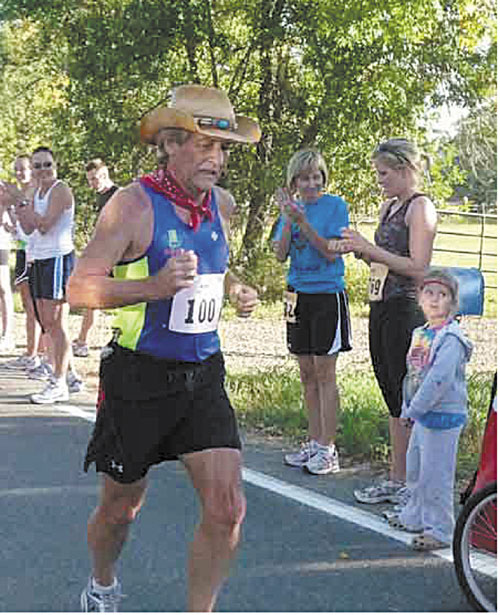
“I’m always encouraging people to do things that they think they can’t do,” Bishton said. “The reward that you get, the sense of accomplishment, is just unbelievably fantastic. There’s something about the marathon distance, I think.”
Bishton would know, because he has enjoyed that reward again and again. Bishton, who lives in Fort Myers Beach, Fla., is flying in to Maine to run in Sunday’s Sugarloaf Marathon. It will be his 223rd marathon.
Now, it’s certainly impressive to complete more than 200 marathons in one lifetime. It’s even more impressive when you consider that Bishton is 62 and is still regularly running a 26.2-mile course in under four hours.
But here’s the real eye-popper: Bishton didn’t start running until he was in his mid-50s, so all of those marathons have been checked off in the last 7 1/2 years.
About 10 years ago, Bishton made a New Year’s Resolution to lose weight. Before that point, he thought he was doing pretty well by mowing his one-acre yard with a push mower instead of using a riding mower or hiring someone to do it for him.
“In the winter-time, I wasn’t really getting any exercise,” Bishton said. “When I cracked 200 lbs., I decided I had to do something.”
Bishton says he had never purposely walked a mile for exercise in his life, but very quickly he was walking five miles a day. Within eight months, he had lost 60 lbs., and as he walked, he was fantasizing about running marathons. So, as simple as that, he decided to take that step.
“The natural inclination is to start slow and work your way up,” Bishton said. “I was raised by two parents who just said, ‘Do it.’ When I was 10 months old, my parents threw me into a pool and said, ‘Swim’ — and they filmed it with a 8 mm camera.
“I basically said, ‘Why can’t I do a marathon?’ You can almost oversimplify it, and say anybody can run a marathon.”
Bishton’s first marathon was in October, 2004, in Baltimore. He kept running, and his goals kept evolving. He never thought he’d get to 100 marathons, so he decided to try to complete 50 before he turned 60.
Then he decided to run a marathon in every state. He did that, and then went through every state again, running a different marathon each time. Then he went through all 50 states a third time.
He heard about the Marathon Maniacs club, which grades the most dedicated marathon runners from one to 10 stars. To get to 10 stars, you have to do one of the following three things within a 365-day period: Run 52 marathons, do 30 marathons in 30 states, countries or Canadian provinces, or run marathons in 20 countries.
Bishton tried, and in his first effort, got to eight stars. He was quite disappointed by that.
“(Since then) I’ve managed 10 stars for five consecutive years,” he said.
A few months ago, Bishton competed in the Savage Seven, on the track at the University of West Florida. To do a marathon, you had to run 105 laps. Bishton did it seven days in a row, Dec. 26-Jan. 1.
“I’m on a beach island,” Bishton said. “My general rule, if it’s up to three to four miles to where I want to get to, I’m going to walk it instead of using a car. That’s just my standard.”
Bishton’s more immediate goals now are completing 50 states for the fourth time, and reaching 300 marathons, because that’s when you start getting on the world ranking lists.
He has never done Sugarloaf, and by competing there this weekend he’s hitting one of the fastest-growing marathons around. According to Ethan Austin, the communications manager at Sugarloaf, the marathon and the 15K race had a combined 410 entrants in 2007. This year, 1,328 runners have signed up.
Austin says there are several reasons for this: Running is becoming more popular, it’s a good “go-to” race in Maine to qualify for the popular Boston Marathon, and the course is essentially flat or downhill for the last 17 miles.
This is good news for Bishton, who has a strained hamstring. But he has also paid for his flight, and those expenses add up. Bishton said he has never got on a calculator and figured out all the expenses for flights, hotels and entry fees. But some people have figured out their expenses, and Bishton says it’s generally around $25,000 a year. So Bishton is running on Sunday.
“I’m not up to snuff,” he said, “but Sugarloaf is scheduled and paid for, and I’m going to fly in to Bar Harbor come heck or high water.”
If you want to see Bishton at Sugarloaf, he’s the guy with the cowboy hat. It has been his trademark ever since he bought one in 2006 at Arizona State University, his alma mater.
The cowboy hat takes a beating — they weren’t really designed for a runner to sweat inside them for four hours and get doused by water — so Bishton has gone through about a half-dozen since then.
Surprisingly, Bishton says the hat doesn’t fall off, although he did have to hold it in place a few times during a marathon on the beach.
On Sunday, Bishton will be wearing the cowboy hat, a 100 marathon singlet and a red bandana he got at a marathon in Abilene, Kan., in April 2007, when the temperature at the start of the race was 19 degrees.
He’s requested bib No. 223 because it’s his 223rd marathon, and he’ll enjoy the finish. But for Bishton, his favorite part of the race often comes around two hours after he crosses the finish line. Maybe it’s someone he talked to at a 5K race, and maybe it’s someone he’s never seen before. But he can tell by the look on their face that it’s the first time they’re finishing a marathon.
“They’re just so proud of themselves,” he said. “It almost makes me cry to watch them do it.”
Bishton’s original cowboy hat was stolen in 2007 at a Kansas City airport. The main thing, though, is it’s a conversation piece. He likes talking to people, and that camaraderie is worth a few delayed flights, a few discarded hats and the soreness that lasts for a day or so after the race.
“You just meet the same people and you develop friendships with them,” Bishton said. “Runners are amazing people. That’s why you do it. You want to see them again and again.”
Matt DiFilippo — 861-9243
mdifilippo@centralmaine.com
Send questions/comments to the editors.
