




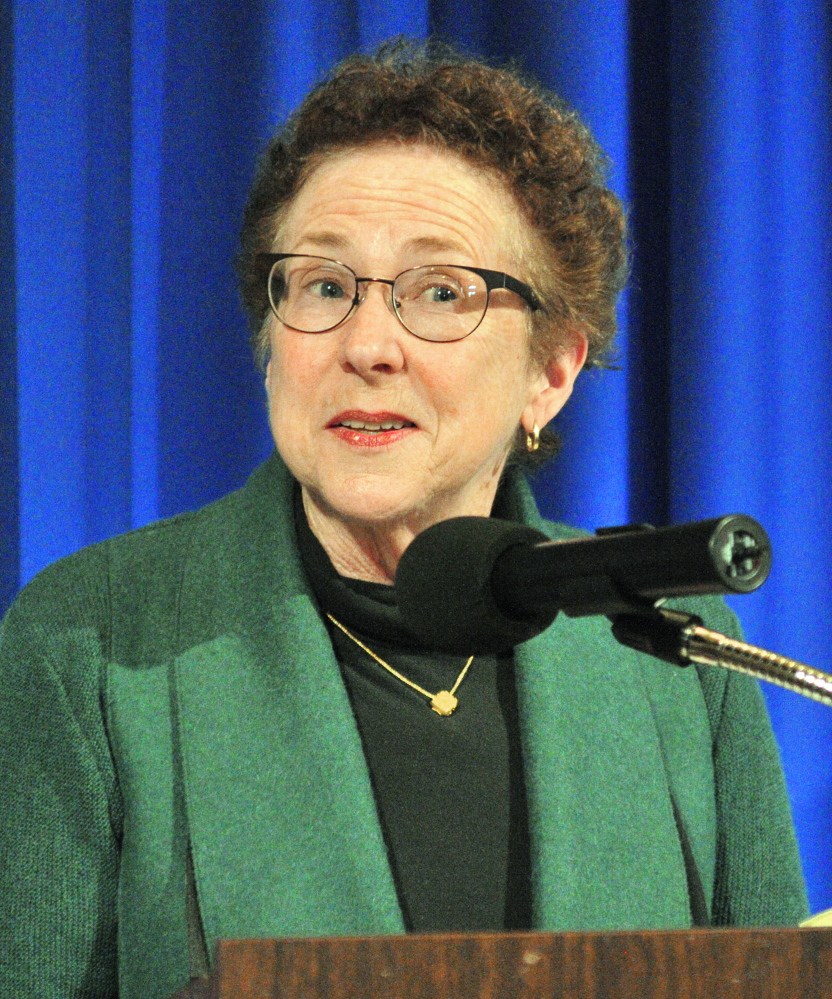
AUGUSTA — Poetry has intertwined with Doris Dean’s life for as long as she can remember.
Her Father, Elwyn Bridges, gained prominence around central Maine as a reciter of poetry. His daughters, Dean and her sister, Ethel Herbert, followed in his footsteps, reciting from memory poetry at Grange halls across the region for more than 50 years.
Dean, of Madison, raised her six children and retired from the dairy farm she owned with her husband, but the poetry remains.
Dean is, perhaps, just who Maine Poet Laureate Wesley McNair has in mind when he speaks of his passion to bring poetry out of the halls of academia and into the living rooms of every Mainer.
“Poetry belongs to the people,” McNair said.
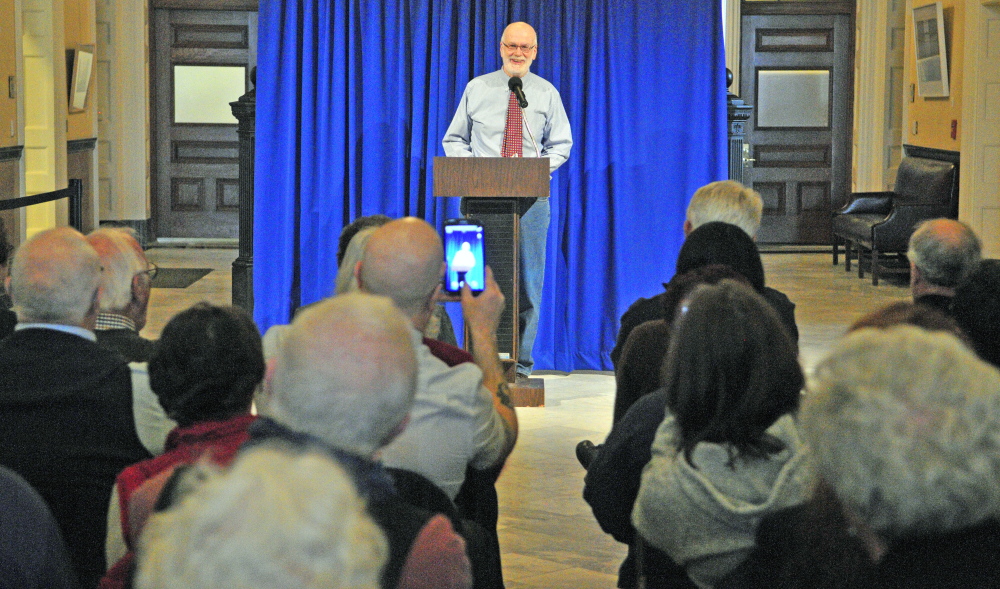
McNair, of Mercer, has spent his five-year tenure as laureate developing programs to introduce poetry to the public square, most notably in the state’s high schools. That effort continued on Tuesday when McNair celebrated the annual Poetry Day in the Hall of Flags inside the State House. Poetry Day is typically an invitation-only event hosted at the Blaine House, but this year’s celebration was free and open to the public.
“We’re bringing poetry to the people of Maine in a new way,” said Charles Stanhope, chairman of the Maine Arts Commission. “Wes often says poetry should belong to everybody, and it does.”
This year’s celebration was marked by nearly a dozen readings given by public figures, such as Maine novelist Richard Russo and television personality Bill Green, and individuals like Dean who simply have a passion for poetry.
“Today is a celebration of Maine poetry,” McNair said.
Dean knows a number of poems by heart, but she decided to present “Betty and the Bear,” a poem about a couple out West confronted by a hungry grizzly bear in their cabin.
“It’s just one people always ask me to recite at the Grange,” Dean said.
Sen. Thomas Saviello, R-Wilton, chose Stuart Kestenbaum’s poem “Cider” because of Saviello’s affection for trees. Saviello said he has read McNair’s poetry in the local newspaper.
“Some I figure out,” he said. “Some I don’t.”
Rep. Victoria Kornfield, D-Bangor, was one of a handful of readers to read a McNair poem. She chose “Love Handles” because unlike other poems, it celebrates neither young love nor mourns the loss of long love, but encourages appreciation for an aging couple who are still deeply in love. Kornfield, who has been married for 47 years, choked up briefly as she read about the couple being “all dressed up to be with the ones they’ve known all their lives.”
Russo — the Pulitzer prize winning author of “Empire Falls” — offered Ira Sadoff’s “My Mother’s Funeral,” which includes a line about a mother who “mamboed with her broom.” Russo said he was a young child when he first came home and caught his mother dancing alone in the house, but it happened again over the years until the woman was well into her elderly years. Russo said the poem resonated with him because he, like the figure in the poem, had an absent father and “a mother who was sometimes all too present.”
Green chose Robert Chute’s “A Revolutionary Soldier’s Reward,” because it sparked memories of finding grave stones in the woods while hunting.
Kathryn Foster, president of the University of Maine at Farmington, was one of the last to read. She, too, chose a work by McNair, whom she described as a modest, decent and smart man who “uses words beautifully.”
“He’s the kind of person, when you speak to him, it’s like there’s no one else in the room,” Foster said.
She wanted a poem that touched on people and places. She settled on McNair’s “Why We Need Poetry,” which speaks of words and their ability to satisfy and change us.
“And when the light itself grows larger,” the poem concludes,
“it’s not the next day coming through the windows
“of that redone kitchen, but you,
“changed by your hunger for the words
“you listen to and speak, their taste
“which you can never get enough of.”
Craig Crosby — 621-5642
Twitter: @CraigCrosby4
Send questions/comments to the editors.
