
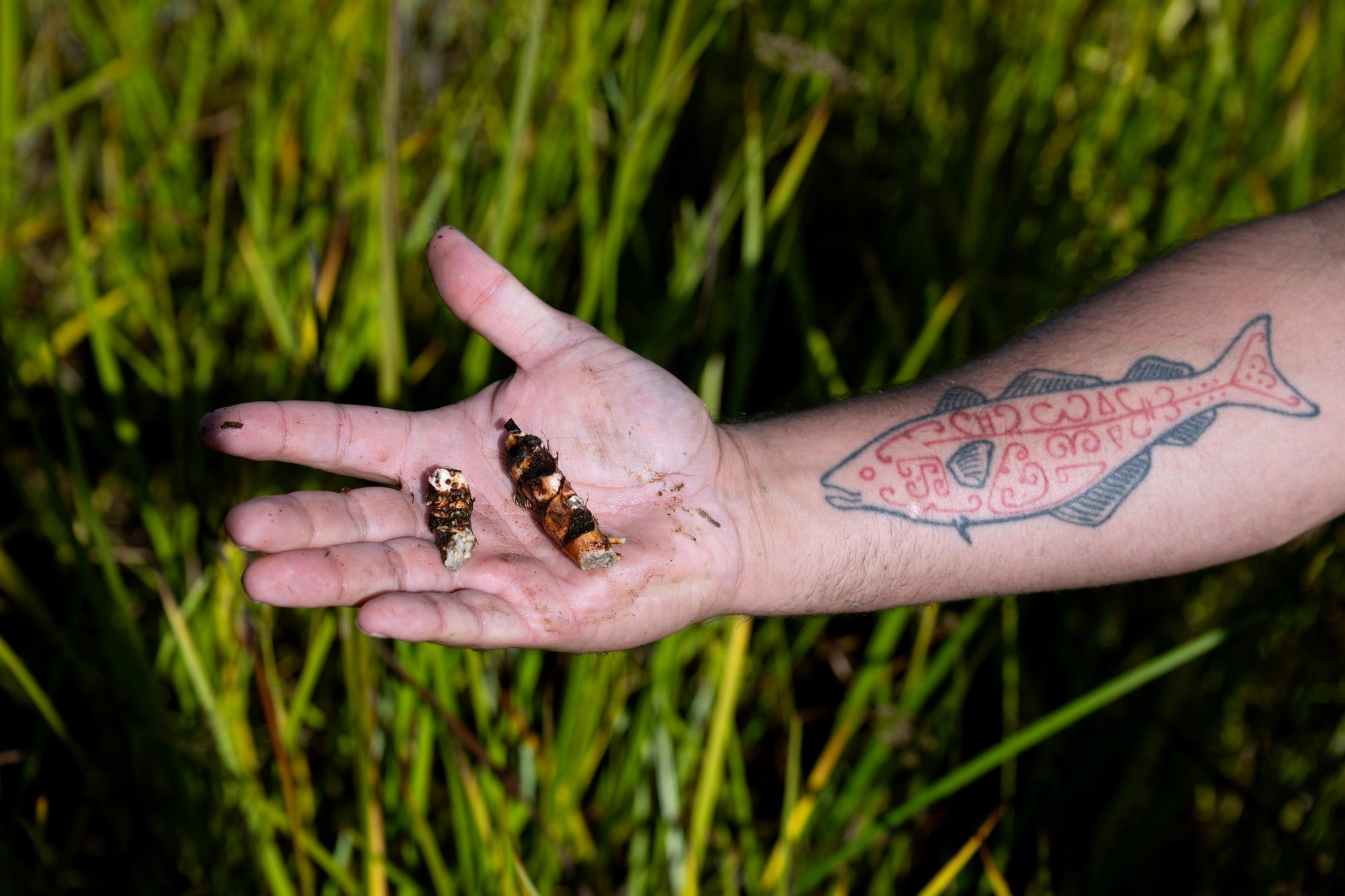
MOTAHKOMIKUK — Standing at the narrows that separate Big and Long lakes, Matthew Dana II curled his fingers around the base of a sweet flag shoot and pried its root from the boggy earth.
He snapped it in two to reveal its light interior and release its earthen scent.
Once dried, flag root — or kiwhosuwasq, which translates to muskrat root, given the rodent’s affinity for the plant — is a traditional Passamaquoddy medicine used to treat, among other things, colds and indigestion.
Dana learned to harvest it in this patch of wetland from his late uncle.
Today, he’s teaching the next generation.
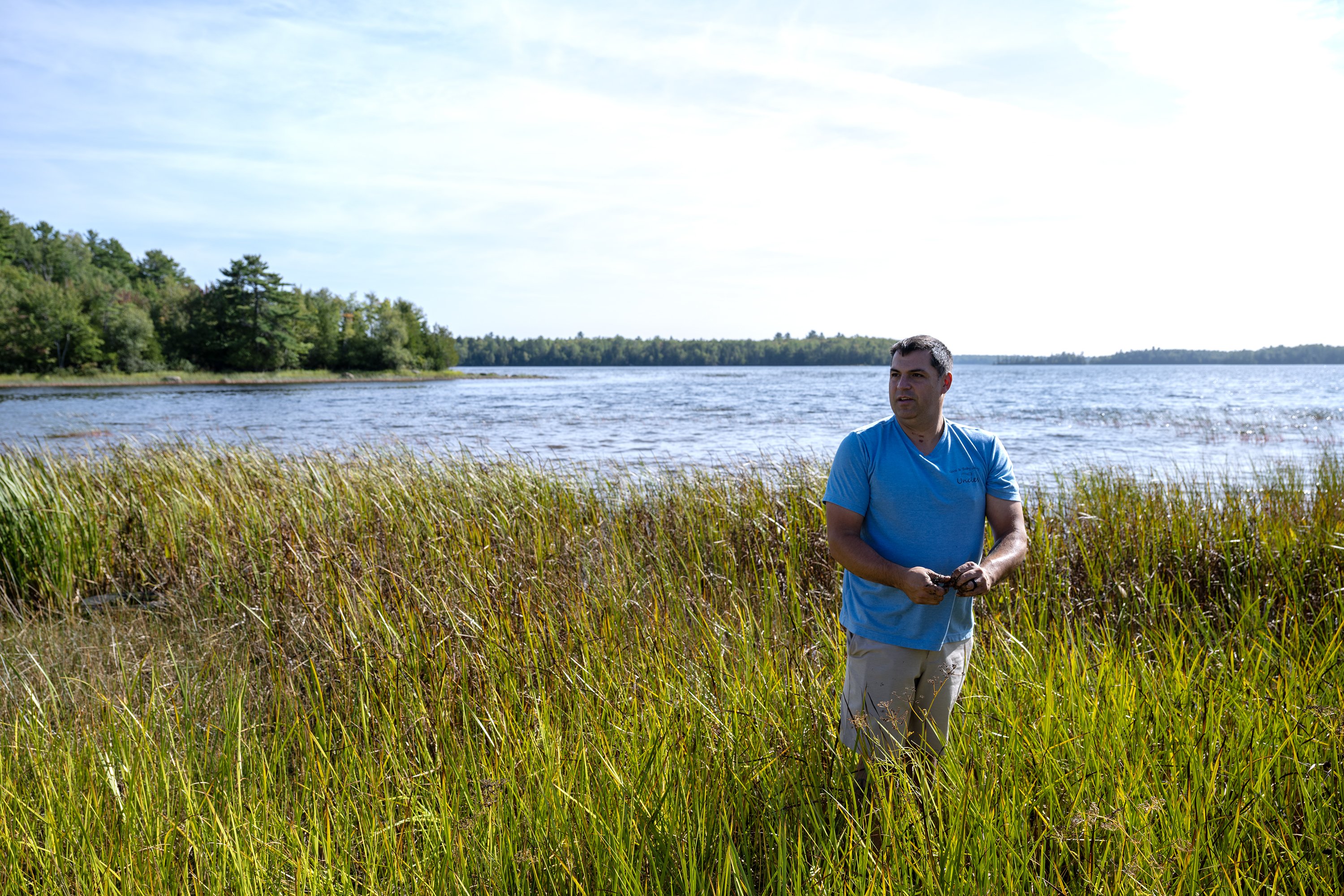
And though working with Passamaquoddy youths has been a passion of his for years, he’s made it into a full-time job thanks in part to a $25,000 grant from the Wolankeyutomone Kisi Apaciyewik Fund.
The fund, the name of which translates to “let us take good care of what has been returned,” is an endeavor of the Wabanaki Commission on Land and Stewardship and First Light.
The commission is composed of representatives of all five Wabanaki communities in Maine: the Houlton Band of Maliseet Indians, the Mi’kmaq Nation, the Passamaquoddy at Motahkomikuk Indian Township, the Passamaquoddy at Sipayik and the Penobscot Nation. First Light is a group of allied nonnative organizations.
Together, they are accelerating the return of land to Wabanaki Nations.
The Penobscot Nation regained control of 11,000 acres last month and the Mi’kmaq Nation’s holdings nearly doubled when the tribe obtained title to 3,400 acres in June. These are all part of a plan to return 50,000 acres to tribal governments.
“Just getting the land back doesn’t mean that our communities are going to be properly resourced to be able to go out there and engage with the land,” said Frances Soctomah, the fund manager.
That’s where the grants come in.
Wabanaki individuals, nonprofits and governments are eligible to apply for grants of $25,000, $50,000 and $75,000, respectively. In the first two years, the fund has distributed a total of $1.6 million in 32 grants across all five communities. Projects support work around anything from food sovereignty to cultural tourism to trail building.
The fund itself, designed to support Wabanaki self-determination, breaks the mold of traditional nonprofit fundraising. Soctomah and First Light plan to grow it into a multi-million dollar self-sustaining endowment that will support this kind of work in perpetuity.
Conservation organizations, Maine and national philanthropic foundations and individual donors all contributed in equal part in the initial fundraising. Donors in Maine included the Elmina B. Sewall Foundation, Maine Coast Heritage Trust, the Onion Foundation and the Quimby Foundation.
The application is low barrier, the grants are unrestricted and the use of donations to the fund is often undefined from the outset because it is intended to support self-determination. That’s sometimes difficult for nonnative donors to wrap their heads around.
“We are integrating more of a trust-based philanthropy approach,” Soctomah said.
But on a recent visit to Motahkomikuk, one of the two Passamaquoddy communities in Washington County, it’s not hard to find evidence of the grants at work.
QUILLS PUT A POINT ON IT
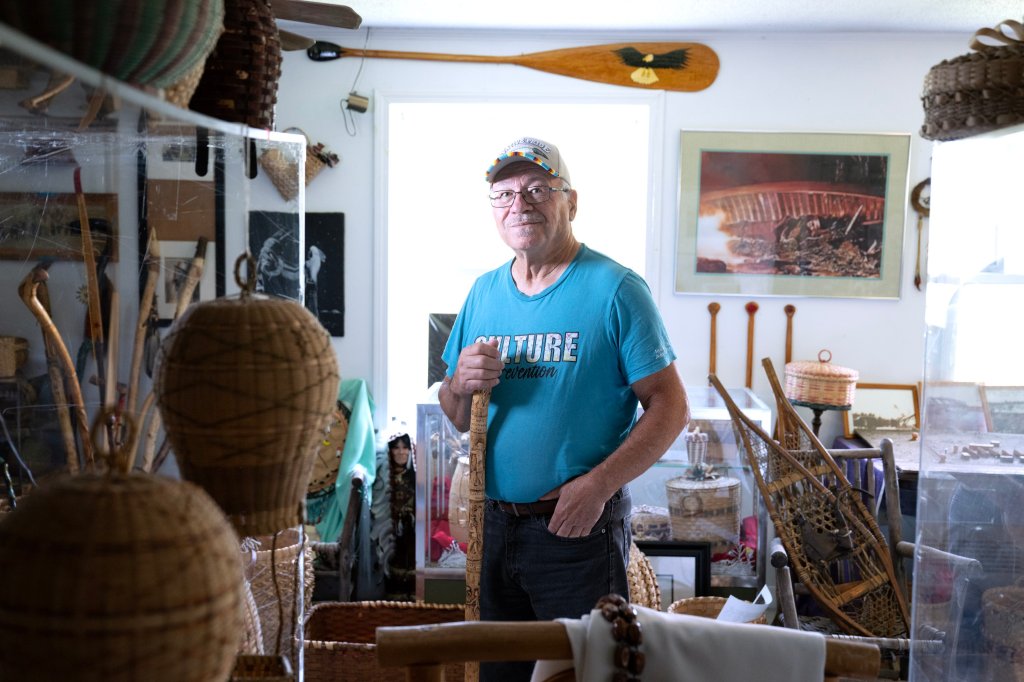
Piece by piece, Donald Soctomah can walk you through the Passamaquoddy Tribal Museum and the myriad artifacts and artworks collected there.
These things just have a way of coming home, he said.
There’s a case of stone tools people have found at their camps and below it, a small Revolutionary War cannon gifted to the tribe by the state in 1820, in gratitude for the service of Wabanaki warriors. The cannon was once lost in the lake, discovered by a fisherman and taken to Maryland, then returned again decades later.
There are baskets, woven by artisans both famous and obscure, and a drum used by the Passamaquoddy Brass Band that toured with Buffalo Bill.
Soctomah, 71, is the Passamaquoddy Tribal Historic Preservation Officer, a former tribal state representative and Frances Soctomah’s father.
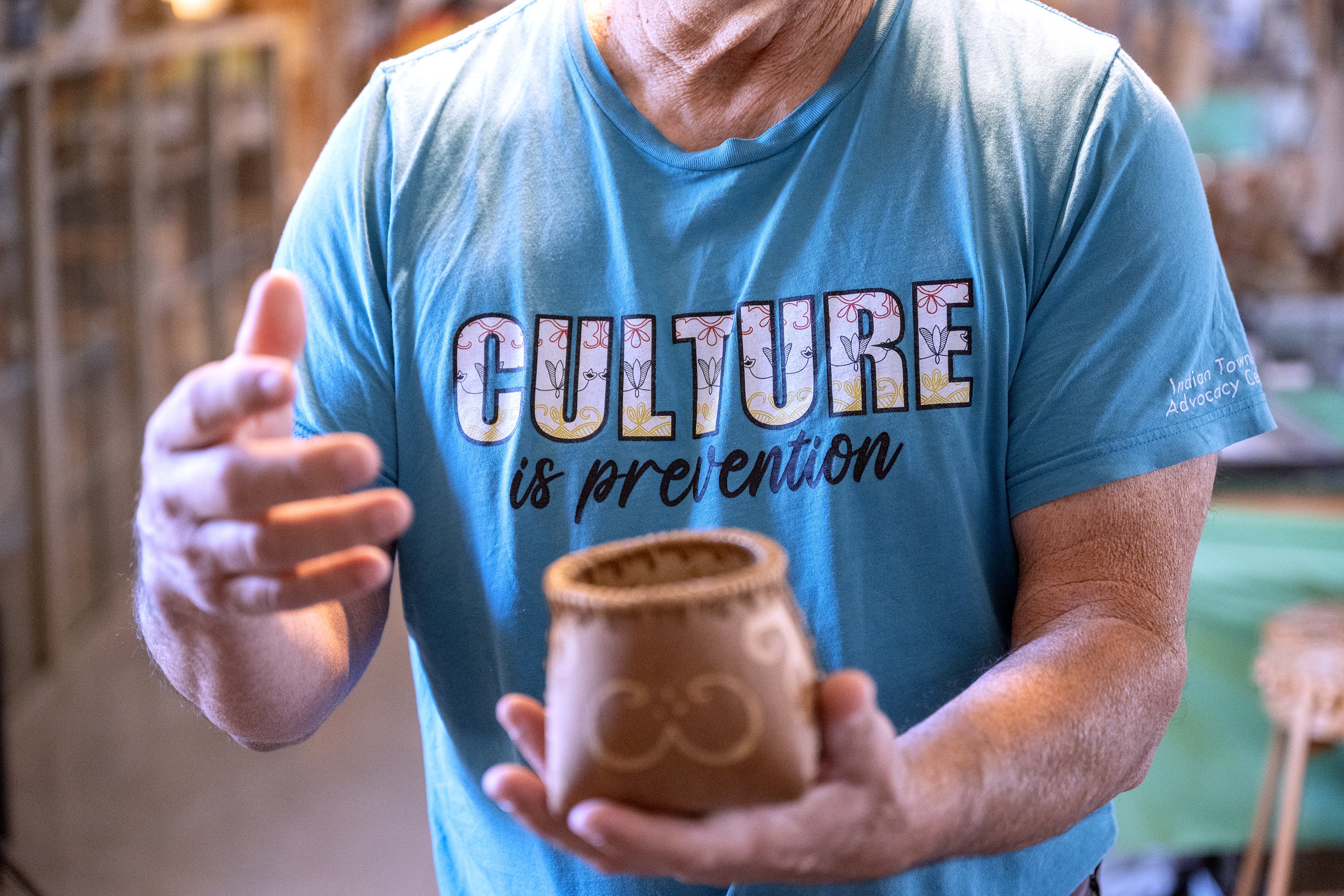
He’s been involved in three grant-winning proposals since Wolankeyutomone Kisi Apaciyewi was launched, including one that supported cultural activities through the museum he manages.
With that grant, Soctomah hired a local artist to lead workshops in porcupine quill art; he was a financial benefactor of this year’s community days to celebrate Passamaquoddy culture with drumming, dancing and a slate of native vendors; and he paid the portage drivers for the ancestral canoe journey, an annual event in which tribal members paddle from Motahkomikuk down the St. Croix River to Sipayik.
These are traditions that run in his DNA. They are traditions, he said, that must be supported.
“It’s the right thing to do,” Soctomah said.
At community days, Alisia Morin, 34, said she spotted a road-kill porcupine as she crossed Passamaquoddy lands that very morning.
She was eager to attend several of the quill workshops Soctomah organized. There, she learned to dye and soften the tubular spikes, and then thread them into a backing to create ornately detailed patterns.
“I’ve always been drawn to how beautiful quill work is,” Morin said.
She grew up in Texas and was not exposed to traditional Passamaquoddy art as a kid. Now, raising her own kids on her ancestral homelands, Morin said it’s important that they have more exposure than she did.
So when she spotted the porcupine carcass, she braked.
If Morin had a shovel, she would’ve taken the whole thing. Instead, she and her daughter, Eliana McGinley, 6, plucked just enough quills to make some earrings.
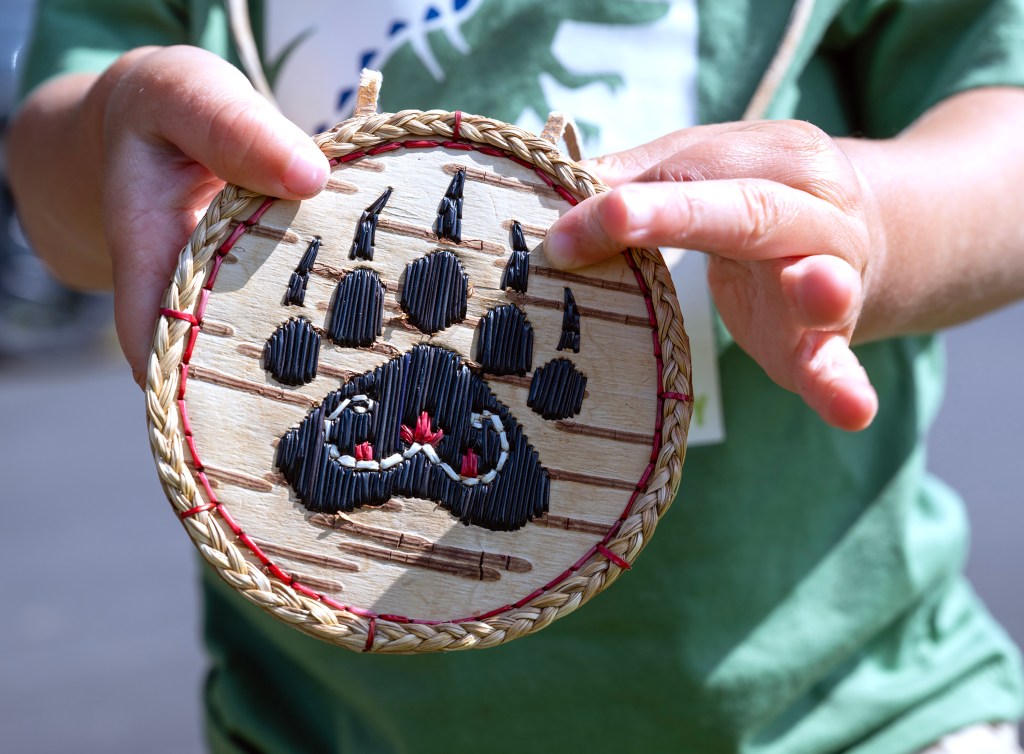
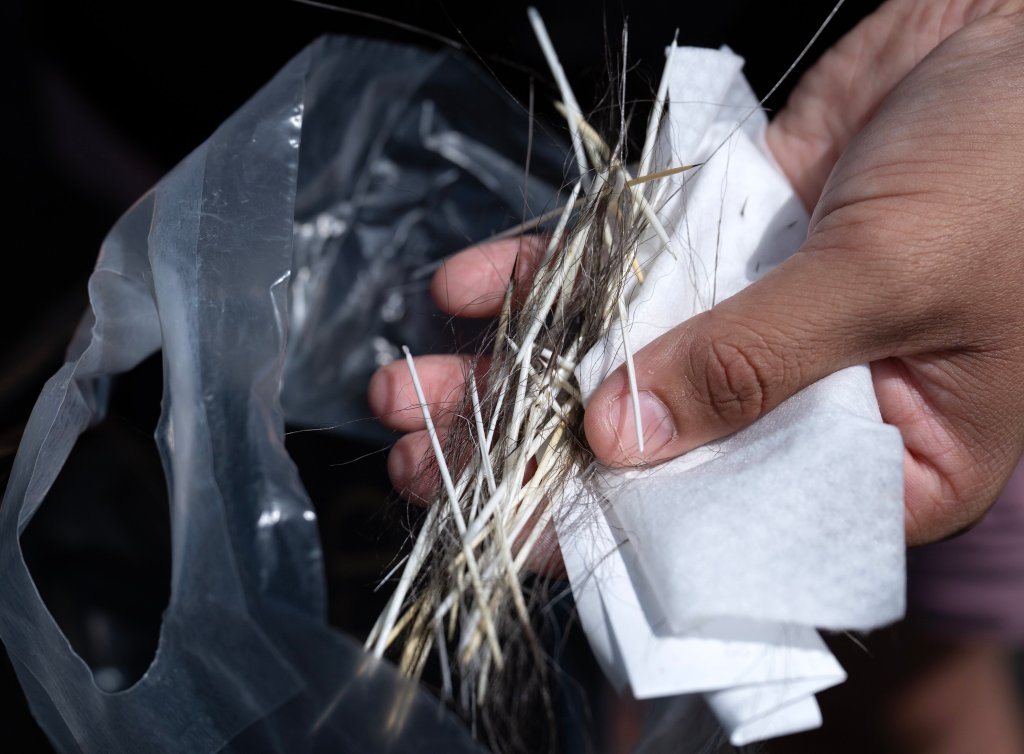
Hudson McGinley, 1, shows off the medallion his mother made by threading dyed porcupine quills through a birch bark backing, at left. At right, Alisia Morin hit the brakes when she spotted the porcupine carcass that morning. (Daryn Slover/Staff Photographer)
“Mom got stuck,” McGinley pipes in, before admitting, “I was a little scared to do it.”
When she pulled out a quilled medallion she made in the workshop, her 22-month-old son Hudson insisted he wear it, and toddled back to the event grounds grasping it with both hands.
ALL ABOUT RESPONSIBILITY
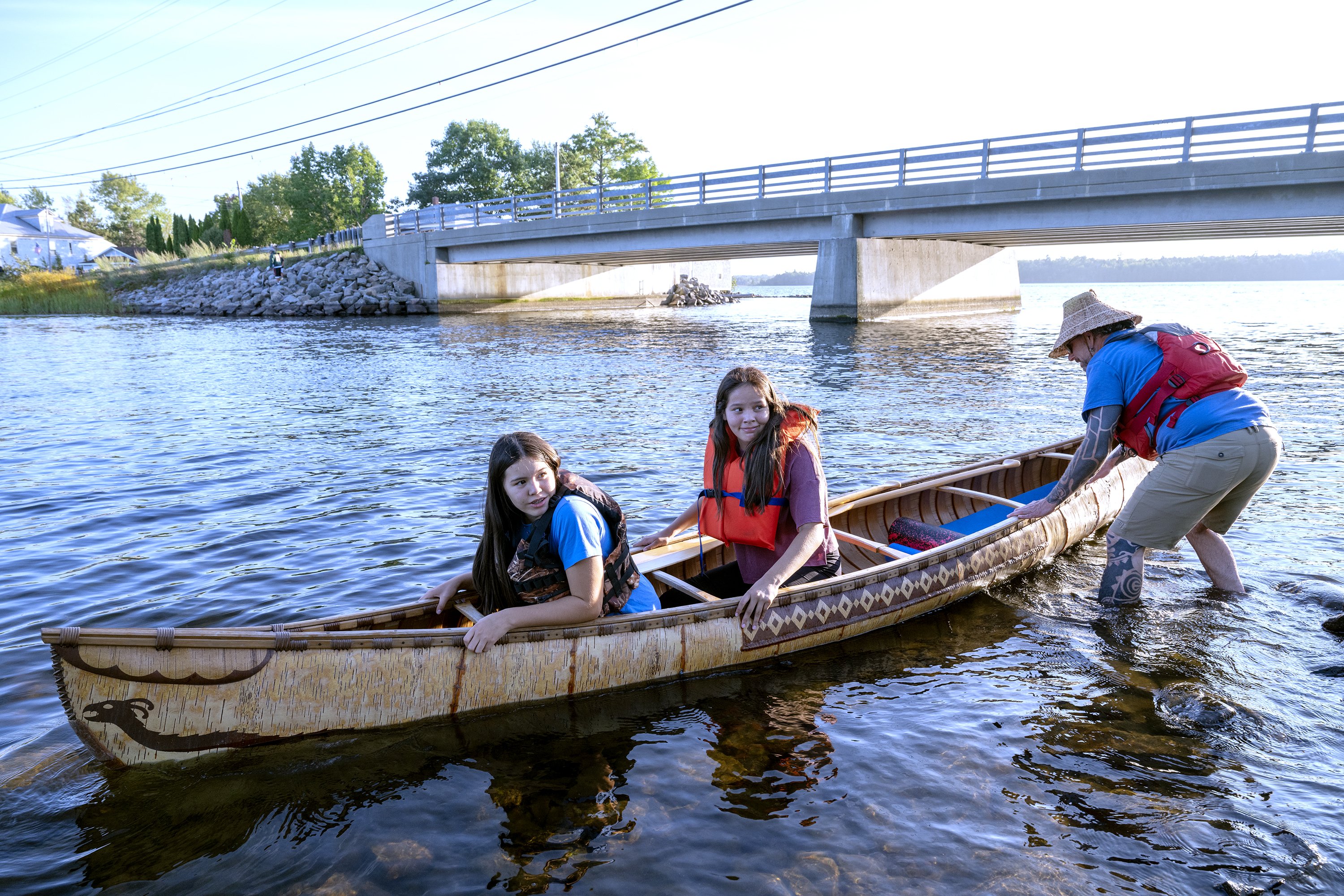
That evening, Eric Bacon steadied the gunwales of his birch bark canoe as a teenager lifted the hem of her ribbon skirt and swung her leg into the shaky hull.
Bacon, who is 49 and has no kids of his own, paddled out into the channel connecting Lewey Lake to Grand Falls Flowage and made a circle.
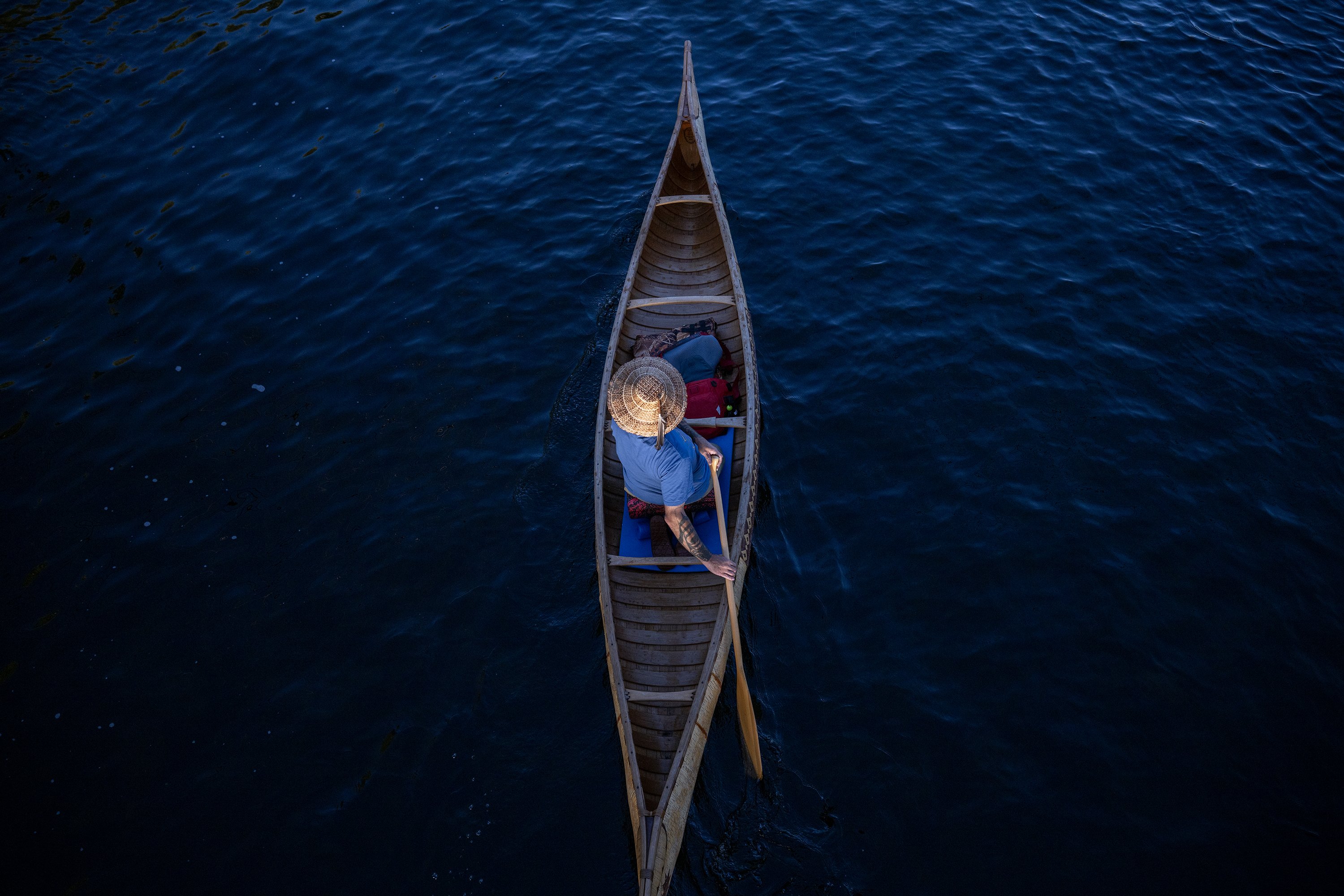
His 23-year-old birch bark canoe was made by master builder Steve Cayard, a mentor of Bacon’s. These boats, constructed in the traditional Wabanaki style, are feather-light.
But the boats have enough gravity to pull the the course of Bacon’s life into their orbit.
He crossed under the bridge and looped back around before drifting up to the rocky shore.
“Let me get out first,” he instructed.
The girls giggled and ran off.
“I’m trying to plant the seed,” Bacon said as he strapped the boat back on his pickup.
In 1981, he dragged his mother by the hand across the grounds at Mihku Lodge to see a birch bark canoe. He was 4.
In a way, everything Bacon has done since has been about trying to nurture that passion.
He received a $25,000 grant to remodel a garage he owns and turn it into a canoe building and birch bark art space where he can host workshops.
The garage isn’t done yet, and Bacon has instead spent some of the money to rent gear for public paddling events. It’s what the community told him it wanted.
Unlike with some other grants, that’s exactly what grantees are supposed to do, Frances Soctomah said. She wants them to have the ability to pivot according to the needs of their community.
Other grant programs often come with burdensome restrictions — food distribution is often off-limits. In one case, Soctomah recalled a funder telling her they wanted to support a basket-making program, but at the 11th hour said the money couldn’t be used on sharp axes, critical tools for harvesting and processing ash trees.
Now, the fund she manages can help fill the gaps for grantees who are constrained by other programs.
There’s a new skiff parked in Matt Dana’s yard. He bought it with the grant money and from it, harvested a porpoise as part of his goal to gather 500 pounds of protein with Passamaquoddy youth.
For Dana, all of this is about fulfilling a responsibility.
As a boy, he learned to trap muskrat from a neighbor, and from his father learned to call them in with birch bark; as a young man, Dana learned to harvest ash and weave baskets from Jeremy Frey, a nationally recognized basket-maker; in his 40s, Dana has sought out elders who can still recall how to hunt seals and process their hides.
After he was awarded a grant in 2025, Dana decided to make this a full-time job.
He’s secured funding from numerous nonprofits in Maine to support the work of Mecimi-te Nihtawehtunen — the name of his organization, which means “we have always remembered.” It’s a phrase that implies that the traditions not only exist, but will continue to.
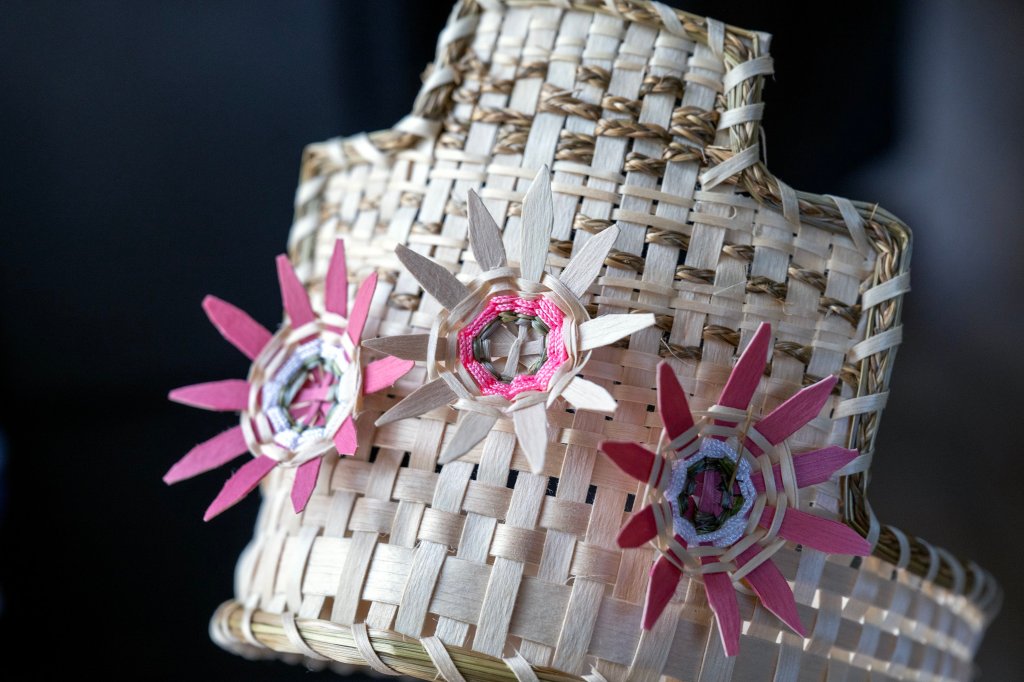
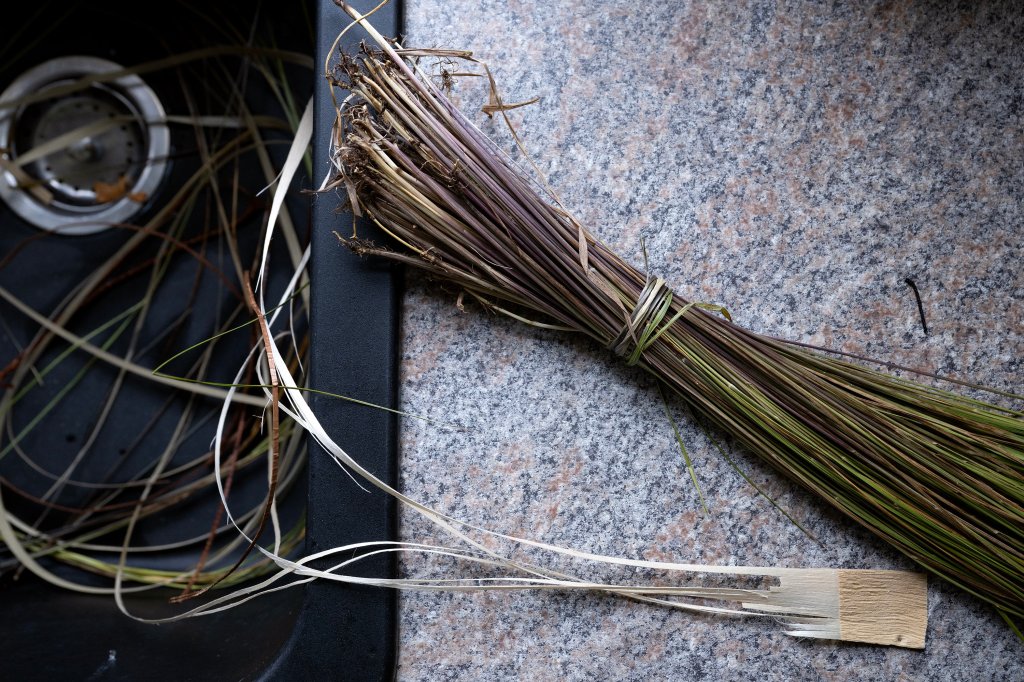
Matthew Dana made a crown from ash and sweet grass for his 4-year-old granddaughter, Sage Dana, to wear during the community days celebration, at left. Sweet grass lays on Dana’s kitchen sink. (Daryn Slover/Staff Photographer)
Coils of ash splints sat bound in a box outside his kitchen, and there are locks of sweetgrass in the sink.
“It’s got to be preserved,” Dana said. “The generations coming after us need to know it.”
He harvested his first moose at 11. By 18, he was out hunting with his cousins and 10 siblings, then his kids and grandkids. In the woods, Dana said placing his palms down flat on the table, he feels grounded.
Two years ago, Dana took his 21-year-old nephew out hunting and guided what was then a timid young man as he harvested his first buck. Last year, they went out again.
Dana’s nephew tracked a buck into the woods as Dana sat listening.
“And then I heard — I heard the shot.”
When they reunited, there was no more fear. There was pride and confidence and joy. His nephew shared the meat with elders in the community.
“It’s ceremony, it’s prayer, it’s connecting with the ancestors,” Dana said. “The feeling of doing something that my DNA has done for over 15,000 years in this same place? Now that’s connection.”
Reuben M. Schafir is a Report for America corps member who writes about Indigenous and rural communities for the Portland Press Herald.
We invite you to add your comments. We encourage a thoughtful exchange of ideas and information on this website. By joining the conversation, you are agreeing to our commenting policy and terms of use. More information is found on our FAQs. You can update your screen name on the member's center.
Comments are managed by our staff during regular business hours Monday through Friday as well as limited hours on Saturday and Sunday. Comments held for moderation outside of those hours may take longer to approve.
Join the Conversation
Please sign into your CentralMaine.com account to participate in conversations below. If you do not have an account, you can subscribe here. Questions? Please see our FAQs.