
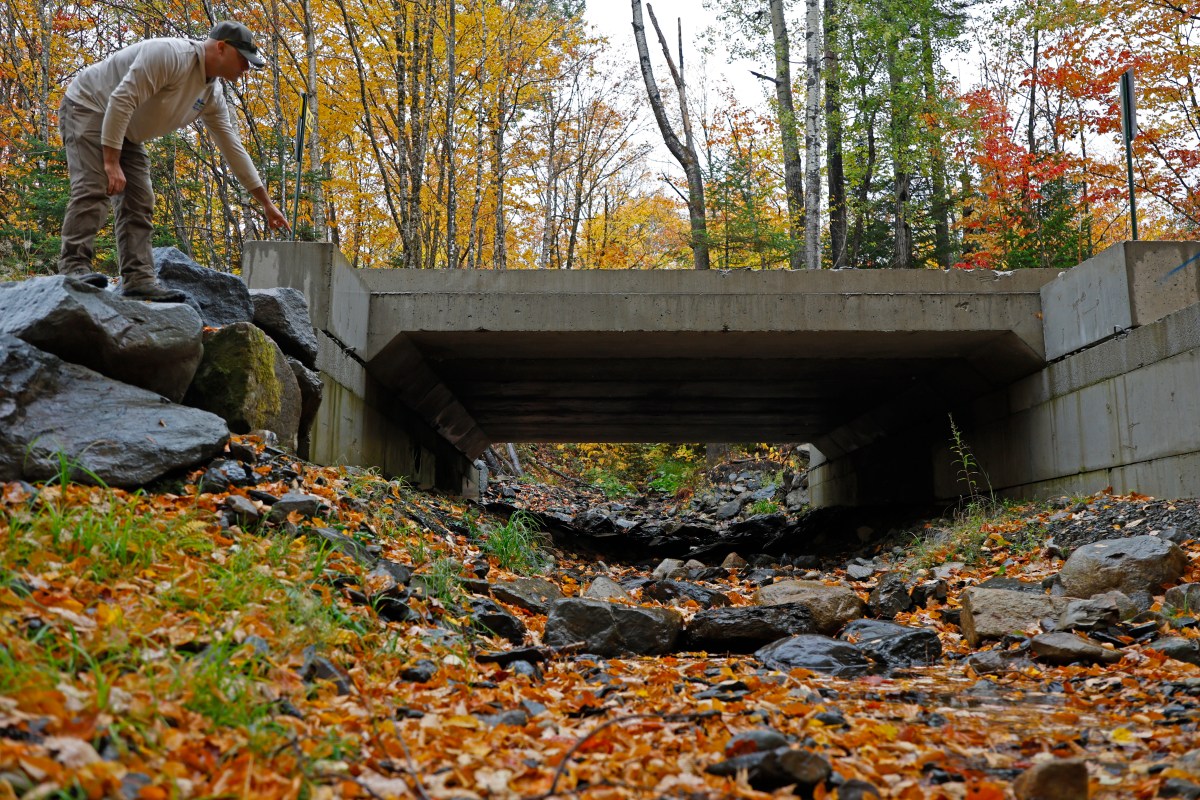
Conservation work carried out by the Rangeley Lakes Heritage Trust seeks to strengthen the resiliency of two waterways in the Rangeley region by replacing aging river crossings and correcting straightened waterways.
In July, more than 78,000 acres around the Magalloway River in northern Oxford County was conserved in a joint effort by four groups, Rangeley Lakes Heritage Trust, Forest Society of Maine, The Nature Conservancy and Northeast Wilderness Trust, which formed the Magalloway Collaborative in spring of 2025.
The four groups have worked together to raise the $62 million needed to buy the development rights to the land.
Although the development rights have been secured by the collaborative, there is still conservation work to be done in the Magalloway, namely in its rivers and tributaries.
WORK TO BE DONE
Rangeley Lakes Heritage Trust has identified many undersized or failing stream crossings that hinder the movement of fish in the preserve, which have been in place on logging roads for decades.
Brook trout are one of the dominant species in the Magalloway and Kennebago rivers. Preferring cold water, they will move upstream in the summer months as the waters warm, choosing rivers and ponds in the higher elevations on the surrounding mountains. The culverts sever access to streams in these higher elevations.
The culverts often sit high off the riverbed, meaning a fish hoping to move up or downstream would have to jump into the pipe and work their way to the other side.
“A lot of studies have shown that, you know, perhaps a few individuals that are more determined can make it through them, but the vast majority don’t,” said Jason Latham, natural resource specialist for Rangeley Lakes Heritage Trust.
Latham said that in surveys done by the Maine Department of Inland Fisheries and Wildlife, one side of a culvert on a brook in the nearby Kennebago conservation area, which has seen much of the same conservation techniques, held more than 130 fish while the opposite side had only two. The culvert cut off nearly four miles of upstream habitat from the majority of fish in the system.
“It was clearly a barrier,” he said.

The organization is moving to replace the culverts, opting instead to install open-bottom bridges that mimic a natural stream bed, which allow fish to freely swim through the miles of tributaries.
“By replacing these culverts and building these open-bottom bridges and replicating sort of that natural condition of the stream, we’re essentially reconnecting miles of upstream habitat for species like brook trout,” he said.
Rangeley Lakes Heritage Trust has replaced nine crossings in its Kennebago preserve, with three left in the trust’s property. Work in the Kennebago will act as a model for the restorative conservation that will take place in the Magalloway in the coming years.
Replacing culverts also strengthens the area’s resiliency to heavy rains and flooding events.
When heavy rain hits the forest, like in the storms that drenched the region in 2023, the culverts can only handle so much water at a time. Latham said that when the region gets hit with multiple inches of rainfall, all of the water is moved down the mountainside and into the blocked streams.
These culverts can become overwhelmed by the water, causing soil to erode from around the pipe and polluting the downstream area with deposits from the crossing.

LOGGING LEGACY
Decades ago, lengths of rivers across Maine were straightened by logging companies. This allowed for timber harvested in the surrounding woods to easily float to the mills downstream. But now, years after the last log drive, the rivers in the region still show scars.
Stretches of water along the Magalloway and Kennebago were subject to the same treatment, creating long, channel-like stretches where water has little obstruction.
Latham said that healthy rivers often aren’t straight. Instead, they meander, with fallen trees and rocks slowing the flow of water and providing shelter to aquatic life under the surface. Above the surface, waters spill over to create floodplains that are vital to the surrounding habitat.
To correct straightened sections of water, Rangeley Lakes Heritage Trust plans to fell trees into portions of waterways to help create the natural barriers the Magalloway needs for a thriving ecosystem. Similar actions were taken on the Kennebago and have been a success, Latham said.
River restoration isn’t solely benefiting the forests of the Rangeley Region. It acts as one of the first lines of defense against flooding and poor water quality in communities along the Androscoggin River.
“Everything flows down to the communities that are even more populated below us,” said Molly Shaw, communications director for Rangeley Lakes Heritage Trust.
Communities such as Bethel, Rumford, Livermore Falls and Lewiston all receive water that enters the system through the Magalloway.
The Magalloway begins at the confluence of the river’s West Branch and Third East Branch in Bowman Township at the northern tip of Oxford County. It stretches 40-plus miles through the five unorganized territories south Bowman, then into New Hampshire before crossing back into Maine to become a tributary to Parmachenee Lake, Aziscohos Lake and the Androscoggin River, which flows into Merrymeeting Bay.
“There’s a million different sorts of threats to really good clean water quality that could happen up here at the top of the watershed that impact so many people downstream,” Latham said.
“The Magalloway is the source of fresh water that feeds down to Merrymeeting Bay and dumps into the Gulf of Maine,” he added.
“We have the opportunity, I’ll say, and the responsibility to practice good forest management up here,” Latham said.
We invite you to add your comments. We encourage a thoughtful exchange of ideas and information on this website. By joining the conversation, you are agreeing to our commenting policy and terms of use. More information is found on our FAQs. You can update your screen name on the member's center.
Comments are managed by our staff during regular business hours Monday through Friday as well as limited hours on Saturday and Sunday. Comments held for moderation outside of those hours may take longer to approve.
Join the Conversation
Please sign into your CentralMaine.com account to participate in conversations below. If you do not have an account, you can subscribe here. Questions? Please see our FAQs.